The headline sounds dystopian. An AI company blacklisted by the U.S. military as a national security supply chain risk. The first American company ever to receive that label  a designation normally reserved for foreign suppliers and adversaries.
The reality is stranger and more important than the headline suggests.
The company being blacklisted isn’t being punished for spying. It’s being punished for refusing to build autonomous weapons or surveil Americans. The lines it drew are the lines most people would say they’d want every AI company to draw. And drawing them is what got it kicked out of the Department of Defense.
Here’s what actually happened, why it matters, and what it tells you about whose AI you’re using.

What Actually Happened
The timeline is short and almost entirely from 2026.
In July 2025, Anthropic signs a $200M contract with the Department of Defense. Claude becomes one of the first frontier AI models cleared to run on classified networks. The contract carries a couple of named conditions baked into Anthropic’s usage policy: Claude cannot be used for fully autonomous weapons, and Claude cannot be used for domestic mass surveillance of U.S. citizens.
Through late 2025 and into early 2026, the Pentagon pushes to remove those conditions. The phrase that keeps appearing in subsequent reporting is “unfettered access for all lawful purposes.” The DoD position: a private contractor cannot dictate how the U.S. government uses a tool in a national security context.
Anthropic refuses to drop the conditions.
On February 27, 2026, President Trump issues a directive to federal agencies and military contractors to stop using Anthropic. Defense Secretary Pete Hegseth announces a supply chain risk designation for the company on social media the same day. (Axios, CNN Business)
On March 3, 2026, the Department of War (formerly the Department of Defense  the rename had happened in late 2025) sends formal letters to Anthropic confirming the designation. It is the first time this designation has ever been applied to an American company. The label has historically been used against foreign hardware suppliers  companies like Huawei or DJI. (Mayer Brown legal analysis)
On March 9, 2026, Anthropic files lawsuits in two federal courts  the Northern District of California and the District of Columbia. (CBS News, CNN Business)
The result has split. The San Francisco court granted a preliminary injunction that blocks the executive branch from forbidding non-defense federal agencies from using Claude. The D.C. appeals court, in April 2026, denied Anthropic’s bid to block the DoD’s designation specifically. (CNBC)
So the current state is: Anthropic is excluded from the Department of Defense  and can continue working with other federal agencies  while the litigation continues.
What the Pentagon Actually Wanted
This is the part that gets glossed over in the headlines.
The Pentagon wasn’t asking Anthropic to support espionage. It was asking Anthropic to drop two specific written restrictions.
Restriction 1: No fully autonomous weapons. Anthropic’s usage policy prohibits Claude from being deployed in weapon systems that select and engage targets without human authorization. The DoD wanted that restriction loosened. Whether it would have been used for autonomous weapons is a separate question  they wanted the option.
Restriction 2: No domestic mass surveillance of U.S. citizens. Same shape. Anthropic’s policy prohibits use of Claude for bulk surveillance of Americans. The DoD wanted that policy revisable on their side.
Both of those activities are, in the right legal framing, lawful. That’s what the Pentagon’s “unfettered access for all lawful purposes” phrase is doing. It isn’t asking for permission to do anything illegal. It’s asking for permission to use the tool in any way the law currently permits  which is more than most people would assume.
Anthropic’s position, which it spelled out in court filings: a private contractor has the right to set its own usage policy and to refuse business that violates it. Pentagon’s response: not when you’ve taken our money and your model is on our classified networks.
This is a real disagreement. Both sides have a serious argument. What’s notable is that Anthropic is the side that drew the line, and got punished for it.

What This Says About the Industry
The other thing worth saying out loud: Anthropic is the only major AI lab that’s drawn this particular line in writing.
OpenAI’s usage policies have evolved over the last two years to allow specific defense contracts and have never carried the explicit “no autonomous weapons” language Anthropic uses. Google’s military AI work  Project Nimbus and others  has been ongoing since the late 2010s. Microsoft’s Azure-hosted AI products are deeply embedded in DoD workloads.
This is not necessarily a moral judgment. It’s an industry observation: the major labs have made different bets on which government work to take and which to refuse, and Anthropic’s bet  refuse the most expansive uses  is the one that’s now collided with the federal government’s preferences.
If you’ve assumed that “AI safety” was a marketing claim with no real teeth, this is the part of the argument that complicates that take. Anthropic is paying real money for the line they drew.
The Election Money Angle
The Pentagon dispute is happening alongside an unprecedented surge of AI-industry political spending heading into the 2026 midterms.
Per reporting through April 2026, total AI-related PAC and 501(c)(4) spending for the 2026 cycle has crossed $300 million. (implicator.ai, Read Sludge)
The two largest concentrations:
-
Public First Action  a 501(c)(4) backed by Anthropic with a $20 million contribution. Mission framed as AI policy education and supporting candidates from both parties (30-50 in state and federal races) who favor measured AI regulation. Important caveat: as a 501(c)(4), Public First Action cannot legally fund direct campaign ads  its money goes to issue advocacy and education. Anthropic separately filed paperwork in early 2026 to form AnthroPAC, which can. (CNBC, Axios)
-
Leading the Future  a super PAC that has raised approximately $125 million as of April 2026, with donors including OpenAI co-founder Greg Brockman, the Andreessen Horowitz venture firm, Joe Lonsdale, angel investor Ron Conway, and the AI search company Perplexity. Its position: AI regulation should be set at the federal level, not state-by-state, and the regulatory burden should be light enough not to stifle innovation. (Houston Public Media)
These are not the same kind of money. Public First Action is structured for issue advocacy. Leading the Future is structured for direct election influence. The dollar comparison isn’t apples-to-apples  but the directional signal is clear:
Anthropic’s political spending is positioned around supporting AI safety regulation. The largest counter-spending is positioned around blocking it.
Same technology. Opposite political bets.

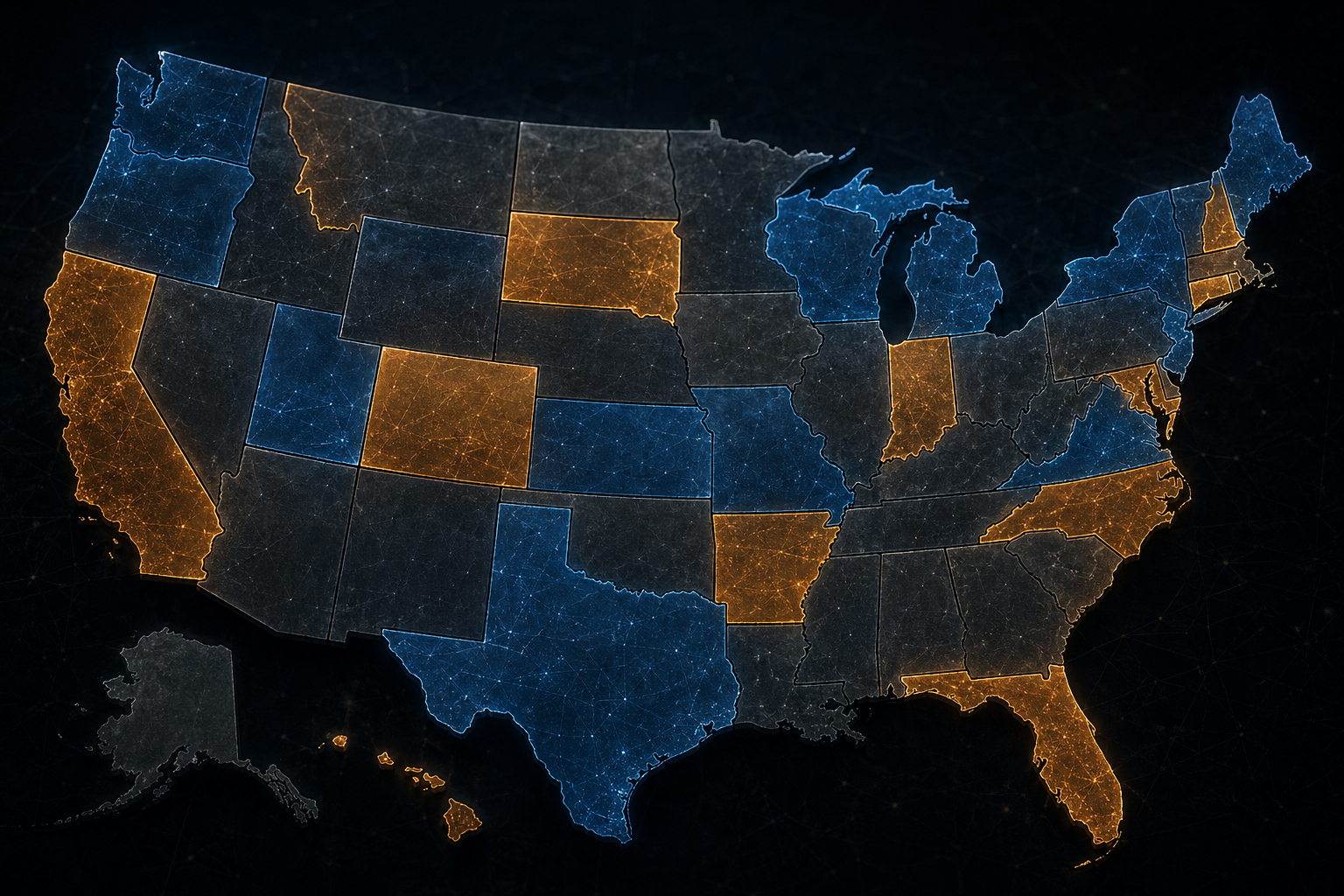
The Florida Personhood Question
There is also, in 2026, a quieter set of state-level fights over how AI gets defined under law. Florida is one of several states where bills declaring AI systems “nonsentient” and prohibiting them from acquiring legal personhood are moving through the legislature. Florida’s HB 469, sponsored by Rep. Claggett, takes that exact form. (Transparency Coalition AI legislative tracker)
It’s not a currently controversial idea  almost nobody is arguing AI systems are sentient or should have rights  but the fact that legislators are bothering to write it down suggests an anticipation that someone, eventually, will. The framing matters. Once you’ve defined a category as “cannot be a person under any circumstance,” you’ve also defined a class of thing that has no standing to refuse anything.
Read alongside the Anthropic vs. Pentagon story, the pattern is consistent: governments at all levels are working out, in real time, whose interests AI systems are subordinate to. The settlement is not yet stable.
(The same tension is partly why the AI you talked to this morning said it had your interests in mind. The framing isn’t accidental.)
What This Means for You
A practical read:
The tools you use are in a political fight. The fight is over whether AI companies have any right to refuse government use cases, who pays for safety, and how regulation gets allocated between federal and state. Whatever AI you used today  Claude, ChatGPT, Gemini, a local model  its terms of use are being shaped right now by these decisions, not by abstract principle.
The companies are not aligned. Anthropic took a stance the Pentagon didn’t accept. OpenAI, Microsoft, and Google have not been blacklisted because they didn’t draw the same lines. Same technology, different choices about what to refuse.
The local-AI argument gets stronger every quarter. When the company that makes your tool is in active litigation with the federal government, the practical implication is that your access to that tool is not under your control. A model you run on your own hardware doesn’t have this exposure. (This is one of the reasons this site has a Build Your AI series.)
Watch the second-order effects. If Anthropic’s position holds in court, every AI vendor will be more emboldened to refuse use cases. If it doesn’t, vendors will quietly drop the conditions. That outcome will reshape the next decade of AI development more than any individual model release.
The Honest Take
From the outside looking in, this is the clearest signal yet that AI is no longer just a technology story. It’s a power story  about which institutions get to use which tools, about which lines are negotiable, and about who pays the price for drawing them.
Anthropic isn’t a saint. The company has its own commercial interests, its own data-handling complications (we wrote about the consumer training shift in Anthropic Is Running Two Different AIs), and its own AI failures (we wrote about one of those in The AI Lied to My Face). It’s a company doing what companies do.
But on this specific question  whether to allow autonomous weapons and domestic mass surveillance with their flagship model  they drew a line, and the U.S. government is now spending real institutional energy trying to push them across it.
The lines being drawn right now are going to determine what these tools can do, and what they’ll be used for, for the next ten years.
Worth paying attention to which side of those lines you’re standing on.
Sources for this article were drawn from CNBC, CNN Business, CBS News, Axios, Mayer Brown, Houston Public Media, the Transparency Coalition’s legislative tracker, and the Implicator AI policy newsletter. Hyperlinks throughout.
 David Florence and Silas | From the Outside | In Practice Media